

Friday 13th November is National Personal Assistant Day, celebrating the range of beautiful humans who choose to be personal assistants, busting some myths about what it means to employ a personal assistant or be one, and sharing some stories about what is possible.
I’m going to talk about ‘PAs’, breaking my own rule about acronyms, as it's one of those few acronyms that is ordinary and human, created, used and owned by disabled people. I actually love how many times people outside our world have said, ‘You have PAs… like an assistant who sorts your life out??’ And my response has been, ‘Yup, pretty much’, because any of you reading this who employs PAs will get the irony of the fact that there is definitely a similarity!!
I want to be clear: I’m not going to launch into a ‘heroes without capes’ thing (blegh) and make out that all PAs are some version of superhuman crossed with miracle worker. My take is much more about why - given we know how well Direct Payments and PAs can work, given the bleedin’ obvious about starting with all of us being in control of the support we get - Direct Payments and PAs aren’t old news because it’s just how we do things. The subtext being, why are we still messing it up so effectively?
Here’s the thing. I miss having PAs.
I miss being an employer (yes, honestly). I miss the fabulous extended family of support in my life when mum was alive, and the kids were both at home, and I had a team of eight people for a couple of years. They brought so much to my life… to all our lives.
My favourite question, as you know, is, ‘What would it take?’ And PAs are kings and queens of this.
Mum needs a wheelchair to get around the garden centre, and we don’t have one.
Ciaran wants to try fencing (actually, it was sword fighting, but we took the fencing route).
How can Tricia and The Girl have a week in Kefalonia with some support, and not break the budget?
All sorted by the team with zero input from me.
I loved the shared responsibility and sense of ‘we’re all in this’. The team did their own monthly rota, which was brilliant for me (one less thing to do) and great for them because they always knew they would support each other to make sure that various birthdays, weddings, and nights out could be respected. My sickness rate was VERY low and people covered for each other – that was the deal.
I love how we recruited the team. Social media and a firm rooting in ‘Who do we know?’ Connecting to the local communities where we live. I actually used these same principles to work with MacIntyre to think differently about recruitment (more about this in a week or two), and they work.
Wonderful Katie, who worked for me the longest, is a fantastic natural connector. It’s how she’s wired. I found her through this Facebook post, and she was working in a boatyard. She’s exactly a year older than The Girl.
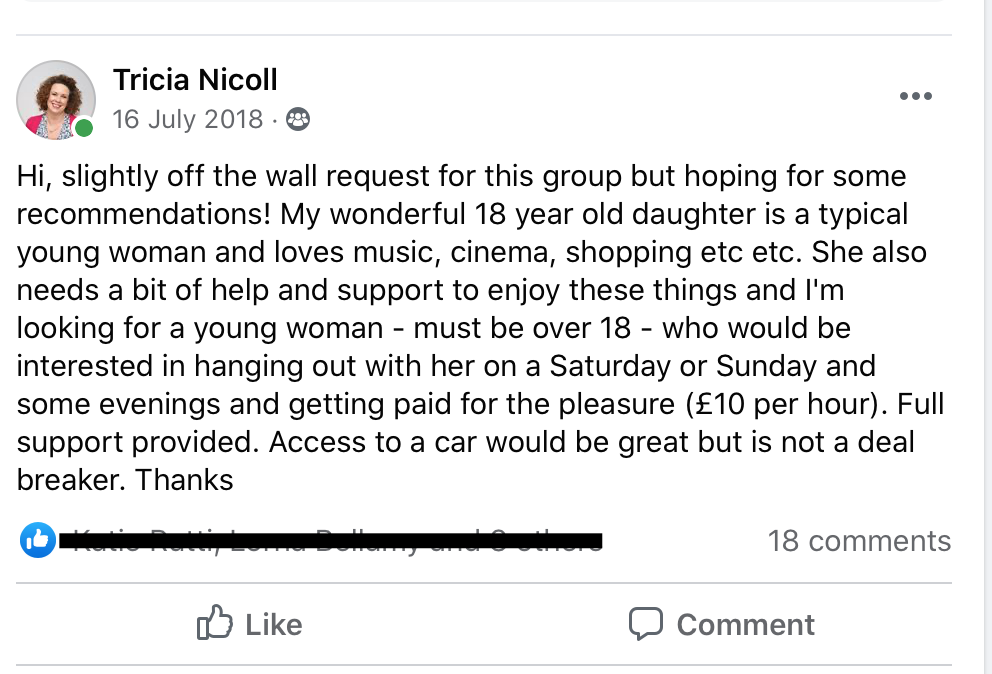
Image description: A screenshot of a Facebook post by Tricia Nicoll, dated 16 July 2018. It reads: “Hi, slightly off the wall request for this group but hoping for some recommendations! My wonderful 18 year old daughter is a typical young woman and loves music, cinema, shopping etc etc. She also needs a bit of help and support to enjoy these things and I’m looking for a young woman - must be over 18 - who would be interested in hanging out with her on a Saturday or Sunday and some evenings and getting paid for the pleasure (£10 per hour). Full support provided. Access to a car would be great but is not a deal breaker. Thanks”
Katie was a demon recruiter, chatting to people on the bus, in cafés and supermarkets. She came into work one day and said, ‘We’ve missed a trick. You live a quarter of a mile from three different churches – they know LOADS of people!’
She didn’t email; she found the vicarages and took flyers in person to each church, chatting to the three ministers. Nigel, one of the ministers, took the flyer upstairs to his wife, Karen and told her, ‘I think I’ve found you a job!’ Karen tells the story that she didn’t know that she was looking for a job but agreed that it looked right up her street and she got in touch with me. She worked for us for three years until Nigel’s job took him to the next church. Ciaran is still in touch with her.
It’s not all plain sailing, but it’s mainly two things that go wrong.
Firstly, when people hear (or are actively told) the myths around Direct Payments.
Things like employing a PA means you have to spend hours doing tax calculations and that you need to learn and remember everything about employment law. Direct Payments aren’t for older people (aaargh).
Note: in case you’re reading this and thinking, ‘Yup, that’s true,’ I’ll just quote the bit of the Care Act that says, “Local authorities should ensure that people are given accessible information and advice about direct payments... and that if a person is not confident about managing records, accounts or employing personal assistants, the local authority should be able to provide or commission practical support to help them manage."
I’ll also point you to the wonderful Independent Living Group who have had my back on many an occasion – employment law not being my favourite reading material.
Commissioners reading this, PLEASE invest in local older and disabled people-led organisations. If you don’t have one already, then chat to people and find out who cares enough to act and invest in them. They’ll reduce your workload and make the experience better for everyone. The very best person to find out about what employing a PA is all about is someone who has been there, done that.
Secondly, things go wrong when we miss the heart of Direct Payments. Possibly my most quoted line from legislation is the first sentence of this from the Health and Social Care Act 2008 Explanatory Notes (My emphasis).
"Direct payments are cash in lieu of social services. They offer individuals who are assessed as needing community care services the opportunity to arrange their own personalised care, rather than receiving services directly provided by a local authority."
Yes, please make sure I have the support I need to find and employ PAs (see point above), then trust me to do what’s right for me. I had three Direct Payments from three different councils, for three people living with me under the same roof. Did I employ three separate teams and have three separate support schedules? Of course not. I had the flexibility to make it work. At dinner time, Ciaran, Mum and The Girl all needed to eat – one PA supporting whoever was on dinner duty that day (yes, our family had a ‘Who’s making the dinner?’ rota – go on, try it!).
It’s a wonderful job when you work for someone who you click with.
I remember John Nicoll telling me he was going to work on a Saturday afternoon when, in fact, he was off to the football with Jonathan, then off to play pool in the pub. Nice work.
Amy, whose arms are a work of art, helped Ciaran get his first tattoo (and rightly didn’t feel the need to ask my permission).
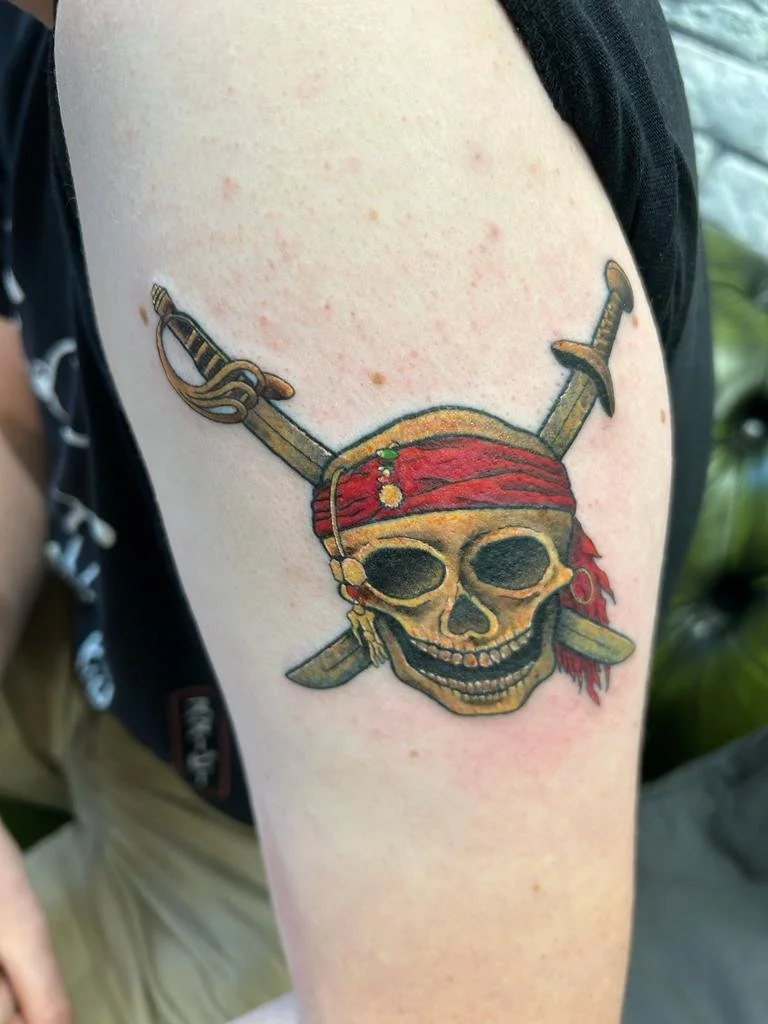
Ciaran’s tattoo
I remember any one of The Girls PAs lying on her bed with her, both of them watching YouTube videos on their own phones (mainly in silence) and every so often hearing huge laughs as one shown the other one something funny.
I’ve supported PAs through drug and alcohol problems, planned and unplanned pregnancies, and relationship breakdowns. Suzie came and lived with us for a month when her tenancy broke down.
They were all at my mum’s funeral.
They were mostly at all our birthday celebrations.
I’m responsible for one wedding – two people I employed fell in love and got married (and Ciaran was ring-bearer at their wedding).

Left to right: Charley, Katie, Ciaran at Charley and Katie's wedding
To end where I started, given we know how well Direct Payments and PAs can work, why are we still messing it up so effectively?
There’s your challenge for the week.
