

Gloriously Ordinary Sundays - 18th October 2026
This is the second part of my musings after speaking at the annual Service Design in Government (SDinGov) event up in Edinburgh at the end of September. The event is focused on how we design public services in ways that really work for people.
In my last blog, I talked about user-centred design and unpicked some thinking about the idea of ‘need’.
This time I feel I might be a bit controversial – even for me! I want to explore the idea of asking people what they want, and the potential limitations of that. Lordy.
We talk a lot, don’t we, about people having a voice, and getting the views of people with lived experience, about making sure that we know what people think as we plan and deliver support. All words that make me squirm, never mind go hmmm… Throw in the co-production word, and it takes it to another level. But I’m not convinced.
Back in the late noughties, I worked with a council to help them think about day services (do we call them opportunities now?) for people with learning disabilities. I organised a series of workshops with people and their families and asked them what they wanted day services to look like. We had tea and cake and a genuinely lovely time. I found out that people wanted to:
Be able to have biscuits with their morning tea.
Be able to paint the walls of the day centre a different colour.
Not have to travel on a minibus to the day centre for an hour each way.
Not to have to be in groups with people they didn’t like, about things they weren’t interested in.
To be able to bring their dog with them.
I worked hard with the council to make these things happen. Bringing the dog proved hard. We had painting parties. We had competitions to dream up new and exciting group activities. The council did a genuinely great piece of work looking at where different people in the staff team lived and whether they would be able to pick people up on the way to work, using pool cars. There was a real buzz; people said they were happier. Good job well done. I felt very smug.
Hold that thought.
Anyone who knows me is aware that I love everything Apple. I was an early adopter of iPod, iPhone, iPad and Apple Watch. I work on an iMac.
Apple is famously sceptical of asking people what they want.
Yup.
‘It's really hard to design products by focus groups. A lot of times, people don't know what they want until you show it to them (a lot of times).’ Steve Jobs is quoted as saying in BusinessWeek, 25 May 1998. I’ve put ‘a lot of times’ in brackets as it’s often missed out of the quote, but it’s really important, I think.
Apple has historically done little traditional market research or focus-grouping of new products. It’s not that they ignore what people want; they’re just really good at using lots of different ways to notice what is frustrating us, what we need help to make easier, what we need - and then offering it to us.
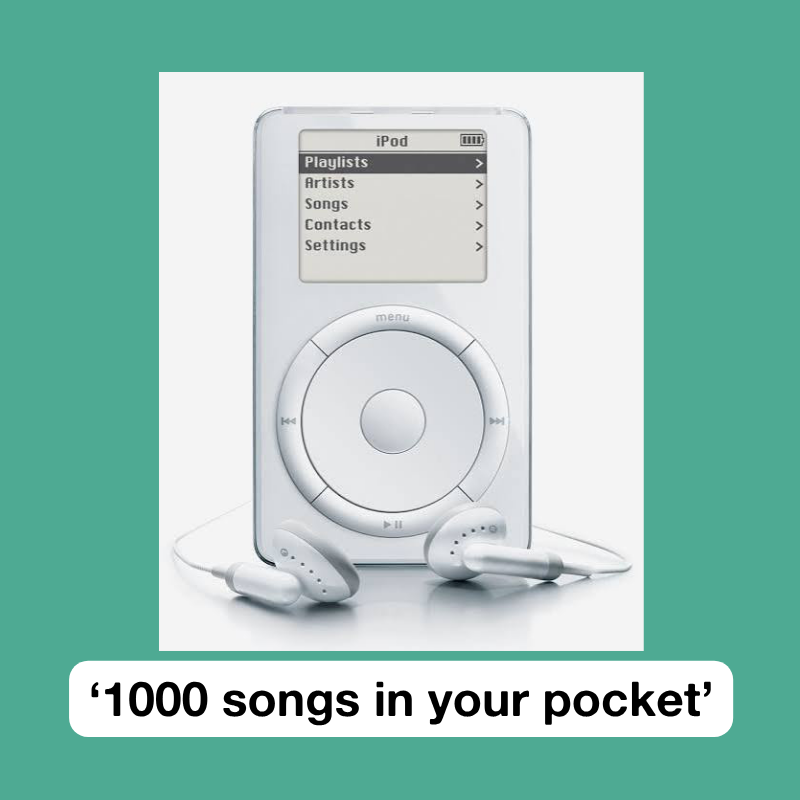
An image of a first-generation Apple iPod with white earphones resting in front of it, on a green background. The caption beneath reads: ‘1000 songs in your pocket.’
Who had one of these beauties? The first iPod, which came out in October 2001. I bought one for John Nicoll for his fortieth birthday and remember quoting the slogan to him, ‘1000 songs in your pocket’. He could not get his head around it, and I have such a strong mental image of sitting in bed with him holding the iPod and saying, ‘1000 songs, are you sure?’
At the time, competitors were talking about gigabytes (I still don’t know what one of those is). Apple were all about what a product meant for your life. Can you see where I’m going with this?
Apple pay very close attention to people, but they just don’t take people’s stated requests as the design brief. Apple design for what they find and identify as the underlying need, not the stated want (in design speak). They observe rather than survey. Much of their insight comes from watching how people actually behave – where we get stuck, where we create workarounds, what frustrates us without us ever naming it.
Would any of us Discman-using folk have asked for something that looked like an iPod in 2000? We can only ask for improvements to what we already know exists; the need we might not even know about is where the new ideas come from. I find that fascinating - how often in social care do we stop and think about people’s lives and say, ’that can’t be working for Bob’?
There’s a big yes but here that I want to acknowledge. Apple can take a big creative bet because if you don't like the iPhone, you don't buy it. In social care, we generally can't walk away. The power imbalance is real, and I am the expert on my own life in a way no customer is the expert on smartphone engineering.
There’s another quote that is often credited to Henry Ford: ‘If I had asked people what they wanted, they would have said faster horses’.
There was a presentation at the SDinGov event from the people who designed the NHS bowel screening programme. It’s an absolutely brilliant programme, as I’m sure any of you who, like me, have been invited to collect and share their poo would agree. It’s completely clear why I need it, easy to do, excellent instructions.
Did I know I needed to check my poo before I was told to? Absolutely not.
Am I incredibly grateful to the person who told me I did? 100%.
If I go back to the council where I worked to ask people about day services, the critical observation I would make now is that not a single person asked about paid work, volunteering or education. They didn’t know it was an option, and no one else was thinking about it.
So, am I saying we should stop asking people what they think? No. It's that what we ask matters enormously.
If you ask me what support I want, I'll usually choose from the menu of services I've already seen. Depending on my situation, that will be some version of:
More hours.
A day centre.
Respite.
That's the ‘faster horse’.
If I know about Direct Payments, have seen people organising their support and getting on with life using them …AND I get a clear message that they are for me, then I might choose them. If I don’t see myself in people using Direct Payments, or if I hear stories of how hard they are to manage, or that they are not really for older people, then I’m not going to ask.
If you instead ask about my life, what a good day looks like, what I miss, who matters to me, where I feel I belong, the idea of need will look very different – friends, love, a place I call home, a reason to get out of bed in the morning – as will the solution.
