

Gloriously Ordinary Sundays - 4th October 2026
I was lucky enough to be asked to be a speaker at the annual Service Design in Government (SDinGov) event up in Edinburgh at the end of September. Its focus is on exploring how we design public services in ways that really work for people. There’s a thing.
Even though I’d been asked to speak, I went down a bit of a rabbit hole. I’m not a designer, so what on earth is service design and what does it look like?
Claude tells me that service design in public services means, ‘planning and shaping public services so they are easy, accessible, and efficient for citizens to use. It moves government systems away from confusing bureaucracy and toward practical, human needs.’
Hmmm…
I knew straight away that I was going to take a slightly different tack, and I’ll explain where my thinking went over the next two Gloriously Ordinary Sundays.
I’m also writing this at a time in October 2026, when politically, there are conversations about social care that just haven’t happened before. Where it feels like there is a real commitment and momentum to create something that works and that matters. They are conversations that are making me edgy, and I’m not doing a great job of joining in.
I dug deep into my rabbit hole and quickly came across the Government design principles – there are eleven, and the first is,
Start with user needs.
Service design starts with identifying user needs. If you don’t know what the user needs are, you won’t build the right thing. Do research, analyse data, talk to users. Don’t make assumptions. Have empathy for users and remember that what they ask for isn’t always what they need.
This first principle is often talked about as ‘user-centred design’ and commonly by the acronym UCD. You know me well enough to know that I was straight onto the wonderful irony of that one.
I’m not even going to unpack the ‘user’ word. I’ll just point you to Bryony’s blog, and the challenge is, of course, bang on. It’s the idea of ‘need’ that got me going.
I’m cool with the idea that, if we want to design a ‘thing’, then we need to know what the user (human) needs. The person who designed the diffuser that goes on the end of my hairdryer deserves a medal – they made it possible for me to actually dry my curly hair, not create a frizz ball.
In broader public services, it’s also fairly straightforward.
I DO need my bins collected.
I DO need to understand how to pay my tax.
I DO need to know the rules about planning and what I can or can’t build in my garden.
Once we’re in our glorious world of social care, the ‘need’ word niggles a lot more. Actually, it’s not just the ‘need’ word on its own. There are absolutely some things I need.
All the things around practical support that enables me to get out of bed and get to work in the morning. That’s a need for sure.
I need to eat.
I need to drink.
I need to get dressed (mostly).
I also need cats in my life and to swim in the lake, but I’m not sure that social care sees that as a need.
I think there are two things here for me. First of all, the idea that life can be boiled neatly down into need and services bothers me.
‘I need this’
‘You can provide that’
It’s the good old ‘needy’ and ‘needed’ thing again. Which are you? You can’t be both. In my experience, we don’t organise our lives as simply as that. I’m needing a lot from friends at the moment – life is complicated. I’m also needed by people, by the woman whose dog I walk and by my fellow altos in the local choir.
It also takes us into the horrible world of us and them, and the pervasive othering in social care. I shared this slide at the conference.
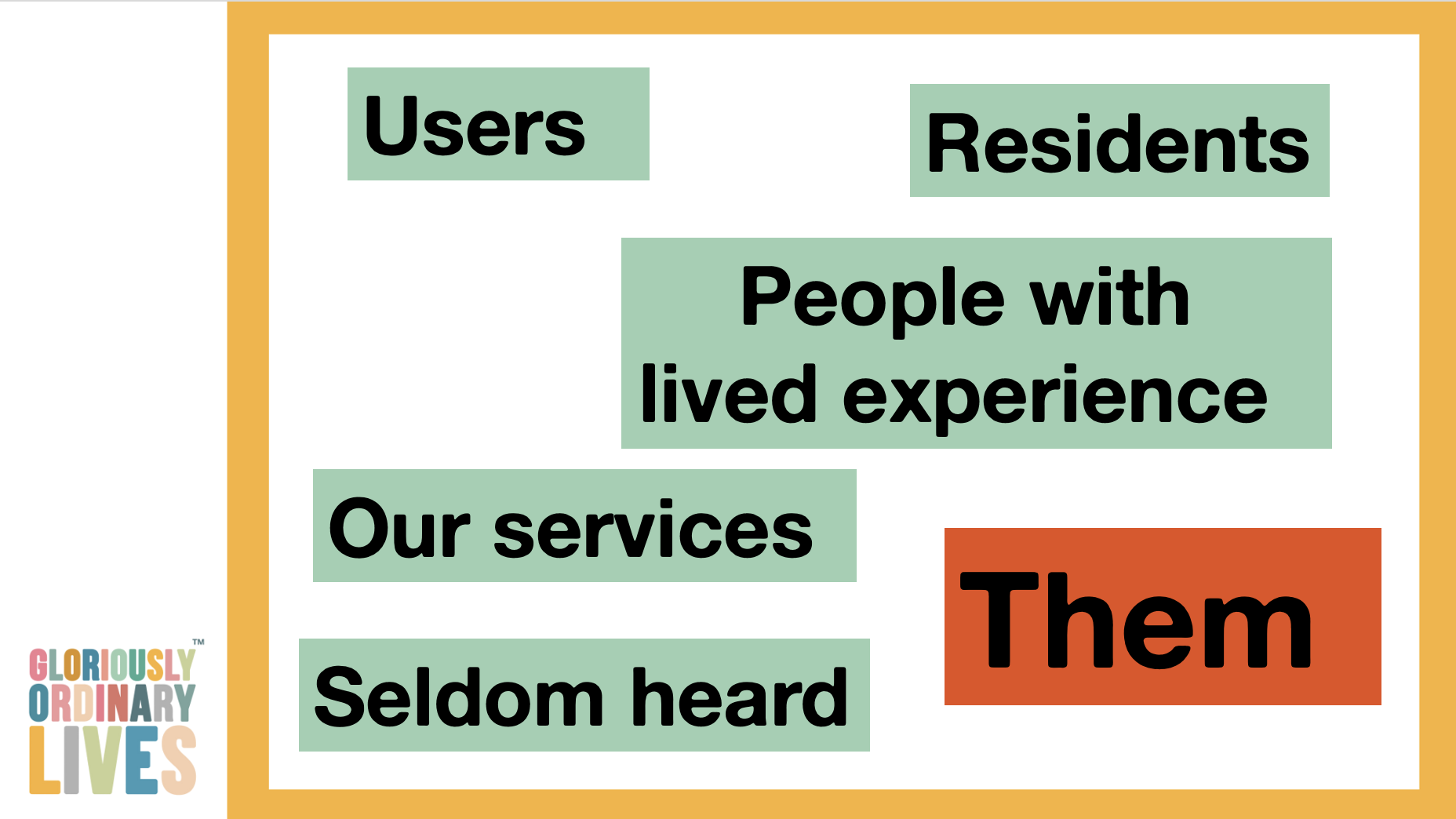
A slide showing six labelled boxes in green and orange, listing terms commonly used in social care to describe people: "Users", "Residents", "People with lived experience", "Our services", "Them", and "Seldom heard." The word "Them" is highlighted in orange, standing out from the rest.
And the second bit, which is linked and is maybe even more important, is the idea that we’re talking about ‘service’ design. Because all needs in life are met by services, aren’t they? Yeah, not so much.
Several of the lovely conversations I had with beautiful human beings over the two days I was in Edinburgh involved challenging the idea that we are simply designing services. And actually, most people I spoke to completely agreed. They said that what we’re doing as great designers is getting to the heart of human lives. Exploring what’s working, what's not working and what needs to change. That also took me to the idea that we are expected to know what we need – more about that next week.
What worries me about our current conversations in the political world of social care is the idea that we could create a safe and solid National Care Service and give everyone free ‘personal care’ (as long as we can agree what that means). We could create something that feels like it has solved the problem of money and eligibility and fairness – in services – but which has failed to really understand our lives as humans. All of us.
The wonderful George Aye led a session one evening called Angry Hour – designed for pissed-off optimists (count me in!). He offered us three questions one by one to chat about in small groups:
What really pisses you off?
What are you hopeful about?
Who are you doing this work for?
I’d like to politely suggest to central government design bods (perhaps someone can point me in the right direction) that we might replace the concept of ‘user-centred design’ with those three questions.
Or the question I shared in Edinburgh,
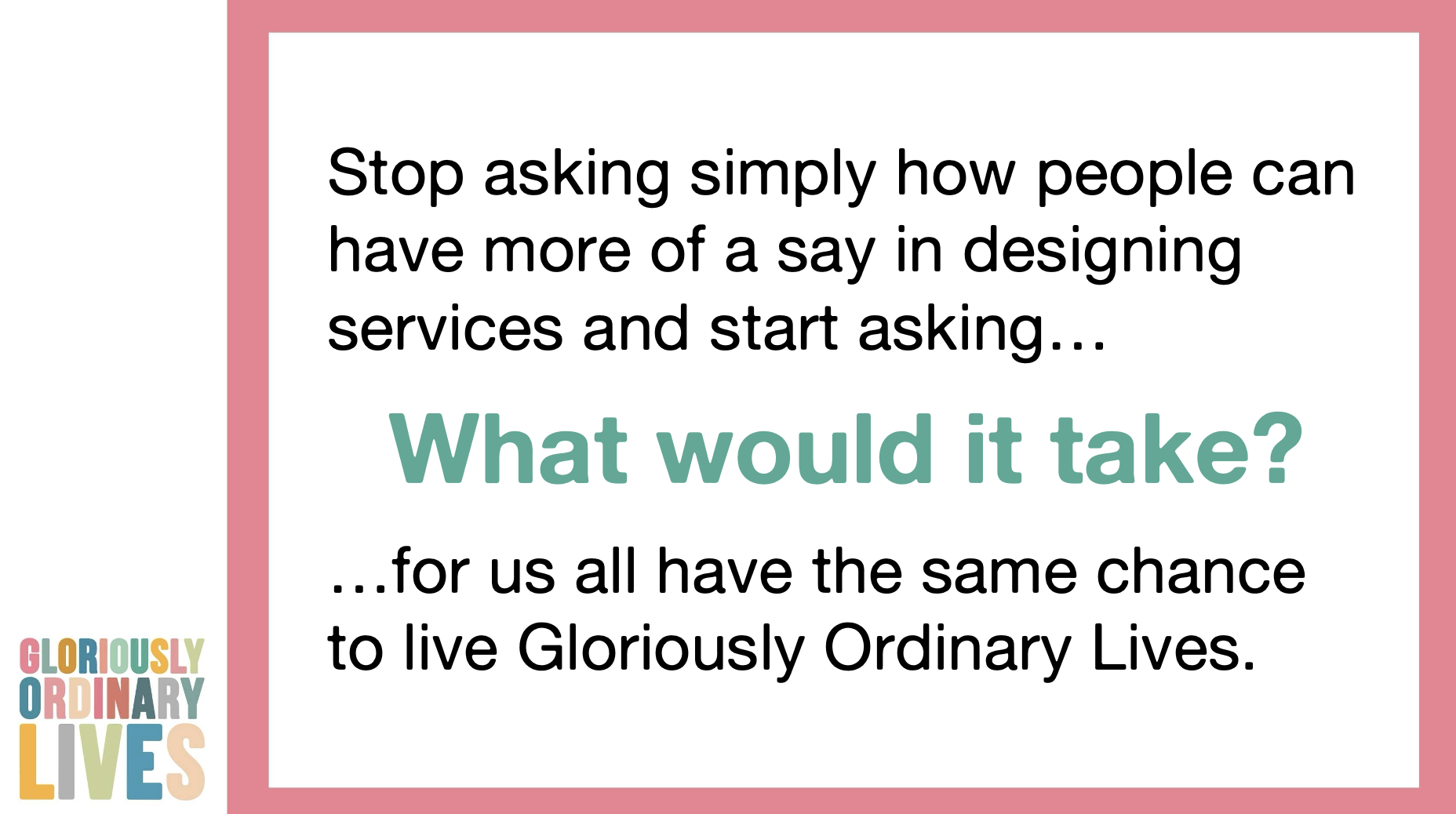
A slide with a pink border and the Gloriously Ordinary Lives logo, posing the question: "Stop asking simply how people can have more of a say in designing services and start asking… What would it take? …for us all have the same chance to live Gloriously Ordinary Lives."
Have a great week.
