Gloriously Ordinary Sundays - 28th June 2026
Dear Gloriously Ordinary Lives friends. Thank you for your patience with me over the last seven weeks since John Nicoll died. It’s been seven weeks of crying and laughing, reminiscing, sorting, planning… oh, and crying.
I’d planned to write a fortnight ago… then last week, and it just felt too hard. Today I’ve sat myself down and given myself a talking to, and I hope you’ll forgive me, but I’m going to indulge myself by devoting this first Gloriously Ordinary Sundays back to sharing some Gloriously Ordinary John Nicoll stories.
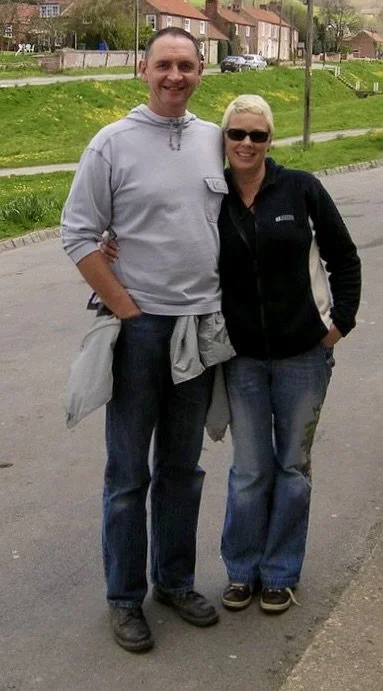
John was all about inclusion. He loved Gloriously Ordinary Lives, but the idea and values of inclusion were his currency.
I was chatting to Bryony earlier, and we were reflecting that inclusion is definitely a deceptive word. It is a beautiful word, and John loved it, but it’s one of those words that gets used in ways that are not true to its heart. I remember that Kyle, John’s foster son, used to be sent to the ‘inclusion room’ at school when he was struggling to be part of a lesson. Oh, the irony.
John was all about real, beautiful, human inclusion – about belonging.
Mainly, I think, because he loved people.
Over the past seven weeks, I’ve come to learn the reach of his ability to connect with fellow humans as his friends and people whose lives he touched have reached out to me with stories. He could (and did) talk to anyone – able to find a connection with someone at the bus stop, the Tesco checkout, in an airport. Literally anywhere.
At the Airbnb I stayed in, as we were sorting out his house, there was this picture in my bedroom, and I had a moment.
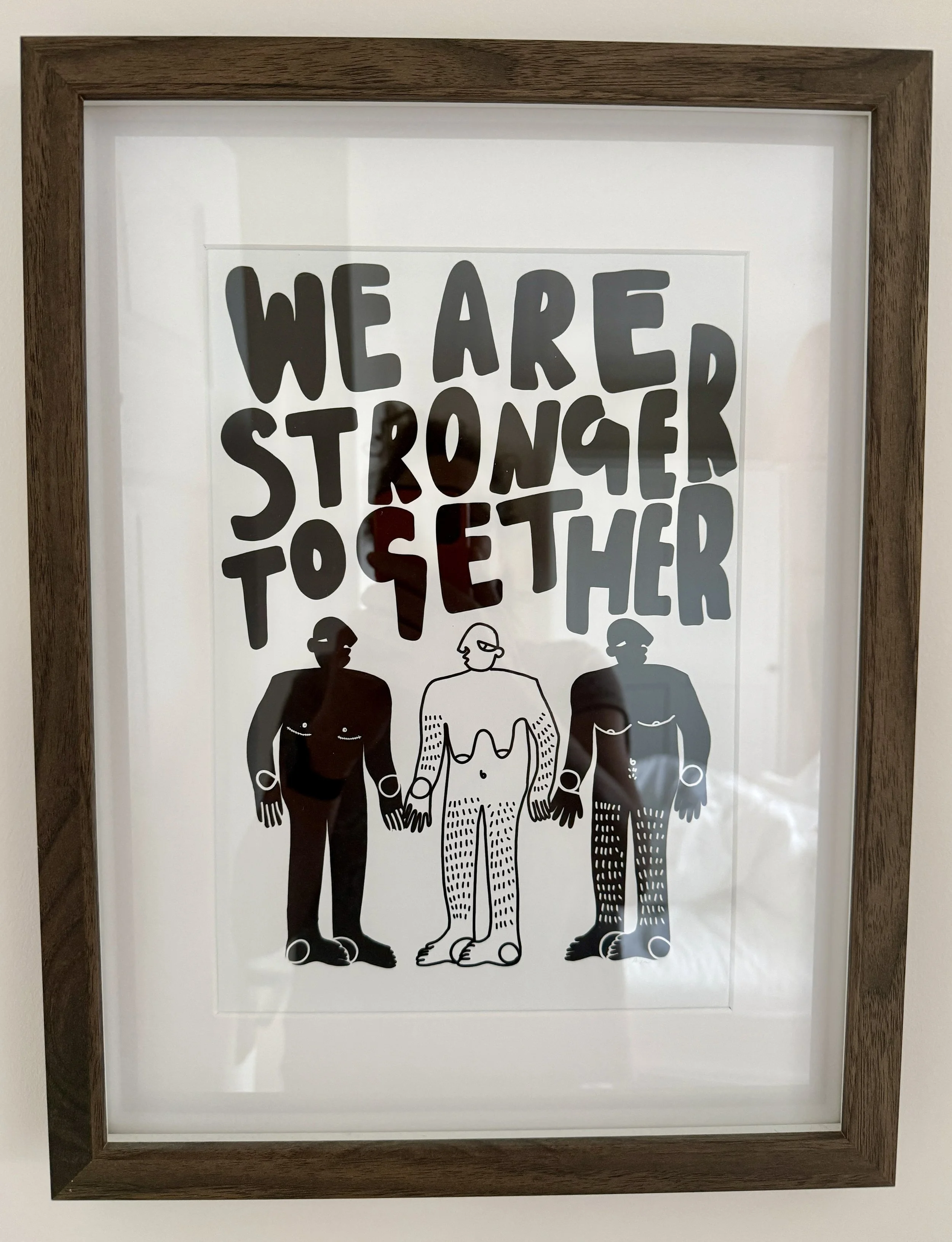
A picture on the wall at an Airbnb I recently stayed in
Back in the late 1980s John trained as a nurse but became quickly disillusioned. I remember him telling me that he was a nurse in a 4-bedded bay on a ward for people living with renal failure – lots of people in the last days or weeks of their lives. The rule was that when he’d finished the ‘nursing tasks’ that needed doing in his bay, he was supposed to go and help nurses in another bay. He ignored this and spent time chatting to people, getting regular disciplinary action for his principles.
He left nursing and went to work at a day centre for people with learning disabilities in Fife. He remembers knowing that it didn’t feel right but not being able to articulate why. Twenty years on, he’d say it was all about people having no purpose, about not seeing what anyone had to offer and about no one paying attention to friends and connections. He did support a couple to get married ...and he won no friends by reporting the worker who used to go and sit in the Snoezelen, wedge a chair against the door and take a nap.
In 2000, there was some new legislation in Scotland called The Same as You that challenged institutions and set out the right of people to live ordinary lives, to be included – jobs, a place to call home, rights and choices. John was offered the chance to take part in some training by Scottish Human Services (known as SHS), led by the wonderful Heather Simmons called Skills for Inclusion, and it gave him a light bulb moment about how social care works… and took him to the SHS conference where we met in November 2000.
Have a listen to Heather talking through the Value of Inclusion, as they really do bring everything into perspective. Six weeks before he died, I was helping him clear some stuff, and we came across this postcard of the Value of Inclusion – a little battered round the edges!
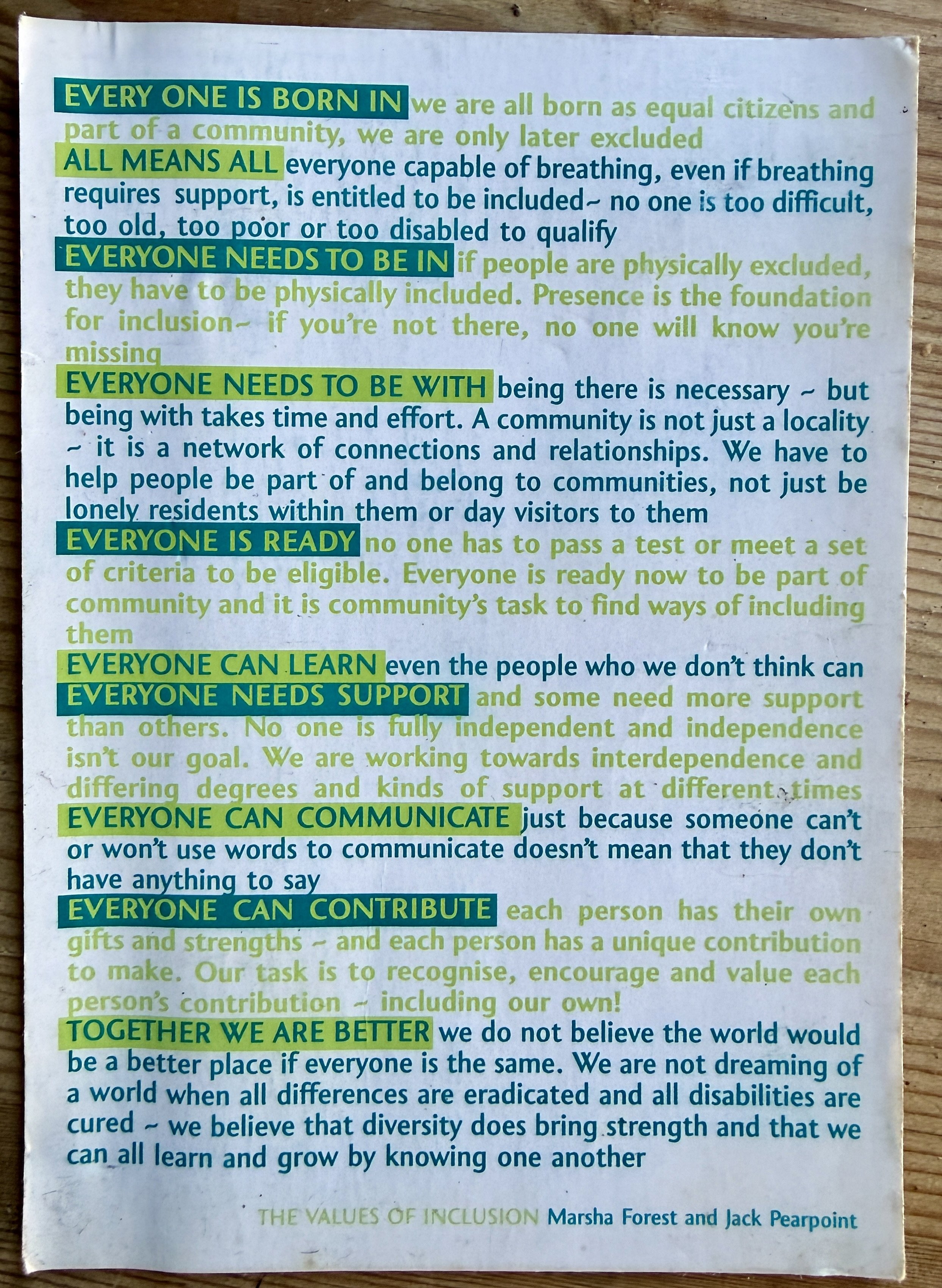
A postcard of the Values of Inclusion
Fast forward a few years, and we were both living in Newcastle. John got a job working to help get the last few people with learning disabilities out of long-stay hospitals (again, oh the irony… the last few people…). He hated it as he said it was just tinkering round the edges – yes, people were leaving a big institution, but they were, in his words, ‘being relocated into mini-institutions’, with little real choice about their place we call home or their support. He said that for the most part, people were ridiculously grateful, and that bothered him. ‘We teach people that shit is ok’ he would say.
I remember him coming home from work one day in tears and saying, ‘How can you take someone seriously if their trousers fall down?’ – he’d been working with Tom, who was in his 50s and who, in hospital, had only had shared trousers. John found that Tom, who had a 32-inch waist, was regularly given 38- or 40-inch waist trousers.
John always did what he believed to be right, regularly not agreeing with and challenging authorities to do the right thing. He never hid behind policies and procedures that didn’t make sense. Always challenged and cared not a jot about the consequences. I loved him for that.
‘Man, it’s just not ok’ was often heard in our house, and I last heard him say it as part of a rant about the support for one of our kids the week before he died. He was right.
Because he was at home, John really led the (low level) fight it took to get both Ciaran and The Girl into local schools, to support them in making friends and having play dates. I know it was something he was really proud of.
Ciaran – who always has a way with words- told me that it was ‘very badly’ that John died and I’m inclined to agree. Very badly.
He was a beautiful human… and infuriating.
Kind, generous.
Funny, very funny.
Stubborn, very stubborn.
Slow …so very slow to do anything.
He could lose a whole day in nothingness… and not even know it. What a gift.
He had a look like a rabbit in the headlights when I said something that freaked him out, or where he thought he’d got something wrong.
He was messy, so very messy.
We spoke every day.
We always finished our calls with ‘love you’
There is a great big, Big John Nicoll shaped hole in every day.
One of John’s catchphrases was ‘peace and love’, and I know he’d want to share that sentiment with you all.